Unlocking the Mystery of Answer Engine Optimization: What You’re Missing Could Transform Your Search Strategy
- Company websites: Product pages, blog posts, guides, and documentation. This is good news for smaller brands: your own useful, specific content can be cited directly. Large cross-platform studies find company-operated websites are the biggest source category overall.
- Independent sources: Reviews, comparison articles, news sites, and industry publications. These give AI tools authoritative information about your brand that doesn’t come directly from you.
- Communities and social platforms: Reddit, YouTube, LinkedIn, forums, and other places where people discuss products and brands. These can matter, but which ones matter most changes significantly by topic and AI tool.
It’s also worth resisting the urge to chase this month’s citation winner. Reddit became a popular target for AI search strategies, only for its share of visible ChatGPT Search citations to drop by about 86% in a single week. The drop happened around the same time ChatGPT changed how it searched the web.
The lesson isn’t to avoid Reddit. It’s not to build your AEO strategy around any one platform’s current citation share. Start with useful content you own, then build a genuine presence in the places your audience already trusts.

Where smaller brands can win in AI search
Bigger brands may have an edge in AI search because they’re already talked about across more of the web, not necessarily because they publish more or better content than everyone else.
That existing footprint can give bigger brands a head start. But it doesn’t mean smaller brands are locked out.
Smaller businesses and creators are often closer to the people they actually serve. You know the specific questions your customers ask, the trade-offs they weigh, and the details a generic answer from a household name tends to miss.
That firsthand knowledge can make a focused, specific answer more useful than something broad from a brand everyone’s heard of. Take your customer’s FAQs and address them head-on with highly targeted content.
You don’t need to outpublish a bigger brand. You need to publish the clearest, most useful answer in the space you already know best and give other people good reasons to talk about it.

One question, several decisions
A person might type one question into an AI search tool, but the answer they actually need often depends on several smaller ones.
Take someone asking, “What’s the best website builder for a small bakery?” They’re not just asking about website builders. The AI is also weighing hosting reliability, ecommerce features, pricing, ease of use, and online ordering before it combines all of that into a single answer.
Google calls its version of this query fan-out: AI Mode and AI Overviews can run several related searches behind the scenes and stitch the results into a single response. It’s a useful example of how the process works, not a rule that every AI tool follows the same method.
Google’s query fan-out video shows this process in action:
That matters because a page that only answers the headline question can miss the details people actually need to act on. Answer the main question clearly, then cover the follow-ups that naturally come next — you don’t need to chase down every possible sub-question to be useful.
Those same follow-up questions are useful for content planning, too. Our guide to building an endless stream of content ideas with WordPress and Claude shows one way to work through them.

How AEO compares to SEO
The biggest difference between AEO and SEO comes down to what you’re actually optimizing for.
Traditional SEO focuses on earning clicks from search results. AEO cares about earning mentions and citations in AI-generated answers — so a click isn’t the only outcome that counts anymore. In that sense, AEO builds on SEO instead of replacing it.
The same practices that help people and search engines understand your content also help AI systems cite and recommend it.
Google’s own guidance supports this: established SEO fundamentals still apply to AI Overviews and AI Mode – no separate playbook required.
If you’re looking for practical ways to structure your content for AI search, our AI search optimization guide covers the essentials in step-by-step detail.

How to tell if AEO is working
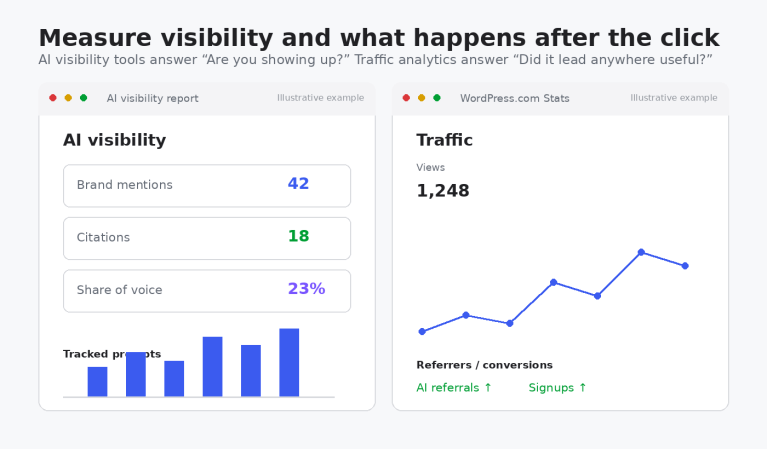
AEO measurement looks different from traditional SEO because there’s a new layer of visibility to track.
Dedicated AI visibility tools like OtterlyAI can show whether your brand is being mentioned or cited across answer engines. That tells you whether you’re showing up in the answer itself.
Traffic tools answer the next question. WordPress.com Stats and Google Analytics can show when those appearances turn into visits to your site and what people do after they arrive.
A no-budget way to track your AEO visibility
However, you don’t need an enterprise tool to start checking whether your AEO work is having an effect.
A spreadsheet and a few repeatable questions can give you a useful baseline. Treat this as a pulse check, not a ranking report.




Post Comment