Unlock the Secret AI Agent That Could Revolutionize Your Writing—Are You Ready to Test It?
Now we arrive at the last post in the series. In the first post, I looked at what AI agents actually are and whether writers need one. In the second, I looked at how much control we might want to give them.
That leaves the question I started with: Where in my process can I use an agent so that I can spend more time writing?

We are creatives. Our processes are as individual as our hair colour. To expect that we all have a common process that technology can simply carry out for us seems, at first glance, impossible. But as we dig deeper, the opportunity is not necessarily finding the common process but rather having a way to identify a candidate within our unique way of working – in the work surrounding the writing: the time-consuming, operational tasks that an assistant could perform and that don’t really require our judgment.
That is what we’re going to look at today. This post will show you a method to identify a potential task, how to develop the instructions to give to the AI Agent, how to build the agent and what I learned along the way. The first lesson was: There are two steps to building an agent:
Step 1: Finding and defining a job.
Step 2: Build the Recurring Agent
You need both, and surprisingly, AI is very useful in both steps.
Step 1: Find a Job Worth Giving to an Agent
This is the place I had the most trouble with. The normal advice is to pay attention to the work you are tired of doing. What do you keep checking? What information are you repeatedly gathering? What do you keep comparing? What are you monitoring because something might change?
The problem is that most of us have developed a system that allows us to be the writers we are. Trying to identify the one step that doesn’t require our attention can feel like looking for a needle in a haystack.
At first, I thought, “Okay, I’ll have AI analyze my whole ecosystem.” AI was very helpful in giving me a process to follow. It was going to take weeks. Time to regroup.
ChatGPT’s recommendations
I asked ChatGPT to suggest three tasks we could use as examples for this post, based on what it already knew about my work.
It took two minutes and recommended:
a) Monitoring and screening marketing opportunities. An agent could search for podcasts, speaking opportunities, book clubs, promotions and other places where The Call to Witchery might be a fit, then screen them before I spend time investigating them myself.
b) Performance reporting across my marketing channels. An agent could gather Substack and TikTok data, compare recent results, flag anything unusual and prepare a summary. I would still decide what the numbers mean.
c) Reporting across wide-publishing platforms. When I distribute my ebook more widely, an agent could potentially gather platform information, normalize it, flag anything unusual and prepare a regular report.
Marketing the book is the most important of the three right now, so that is the one I chose. It also seemed like the easiest to test.
Finding the job for an agent can be as simple as that. Look at what you are working on today. Pick one area as your guinea pig. Then ask the AI to identify three tasks in that area that an agent might be able to help you with.
Pick one.
body .ns-ctt{display:block;position:relative;background:#000;margin:30px auto;padding:20px 20px 20px 15px;color:#fff;text-decoration:none!important;box-shadow:none!important;-webkit-box-shadow:none!important;-moz-box-shadow:none!important;border:none;border-left:5px solid #000}body .ns-ctt:hover{color:#fff}body .ns-ctt:visited{color:#fff}body .ns-ctt *{pointer-events:none}body .ns-ctt .ns-ctt-tweet{display:block;font-size:18px;line-height:27px;margin-bottom:10px}body .ns-ctt .ns-ctt-cta-container{display:block;overflow:hidden}body .ns-ctt .ns-ctt-cta{float:right}body .ns-ctt.ns-ctt-cta-left .ns-ctt-cta{float:left}body .ns-ctt .ns-ctt-cta-text{font-size:16px;line-height:16px;vertical-align:middle}body .ns-ctt .ns-ctt-cta-icon{margin-left:10px;display:inline-block;vertical-align:middle}body .ns-ctt .ns-ctt-cta-icon svg{vertical-align:middle;height:18px}body .ns-ctt.ns-ctt-simple{background:0 0;padding:10px 0 10px 20px;color:inherit}body .ns-ctt.ns-ctt-simple-alt{background:#f9f9f9;padding:20px;color:#404040}body .ns-ctt:hover::before{content:”;position:absolute;top:0px;bottom:0px;left:-5px;width:5px;background:rgba(0,0,0,0.25);}body .ns-ctt.ns-ctt-simple .ns-ctt-cta,body .ns-ctt.ns-ctt-simple-alt .ns-ctt-cta{color:#000}body .ns-ctt.ns-ctt-simple-alt:hover .ns-ctt-cta,body .ns-ctt.ns-ctt-simple:hover .ns-ctt-cta{filter:brightness(75%)}Could an AI agent help make your writing process easier? In this article, we find, test, and build an AI agent that actually helps writers.Share on X
Choose the Tool
You might wonder why you have to pick the tool now. It’s because each tool is unique, and as you’re developing the instructions, you need to be sure that you follow the rules for that tool.
I decided to use ChatGPT Work. Why? Because I was already doing this work in ChatGPT, and the job involved exactly the kind of things Work is designed to handle: researching across multiple sources, checking information, comparing possibilities and producing a report.
AI companies are now putting agent tools directly into the platforms we already use. ChatGPT Work and Claude Cowork are examples of this. Before they came along, people were building custom agents, which required some coding knowledge. You could either build them yourself, taking up writing time, or pay someone to do it for you, costing money. The result for me is that I didn’t see a need to do either.
I am using the browser version of ChatGPT Work rather than the app since I’m already familiar with the look and feel of this for ChatGPT. My advice: Use the simplest version of the tool that can do the job.
Now I needed to tell it exactly what that job was.
You Don’t Need to Do This Alone
Once you identify the job and the tool you’re going to use, the next challenge is figuring out what the agent needs to know so it can do that job well. That can be harder than it sounds.
This is where AI became much more useful. Even though I had identified the opportunity, I had no clue what information the agent needed. I did the only thing I could think of—I asked ChatGPT: Give me the process we should follow. The list it gave me became the goldmine:
- Define the job narrowly.
- Define what counts as an opportunity.
- Define the filtering criteria.
- Decide what the agent can judge and what stays with you.
- Define the search scope and sources.
- Define the output.
- Run it manually.
- Inspect the results and refine the instructions.
- If it earns its place, build the recurring system and schedule it.
ChatGPT as a collaborator in the process
The best part: ChatGPT became my collaborator through every step.
Starting with Step 1, we defined the job:
“Find, filter, and list worthwhile marketing opportunities for The Call to Witchery that fit criteria I define, without taking action on my behalf.”
And moved through each step methodically and collaboratively. I supplied the context, priorities and judgment. ChatGPT helped organize them into something the agent could follow.
That is the part I hadn’t understood before this experiment. You don’t have to invent a perfect agent spec yourself. AI can help translate what you already know about your work into instructions another AI process can follow.
Tip: Have your AI put those instructions into a document you can save and refine as you test.
Test What the Agent Thinks You Want
Now that you have a draft job description, it’s time to see what the tool does with it.
This was another point that confused me at first. I wasn’t building the recurring agent yet. I was testing whether I had described the job clearly enough for an agent to perform it.
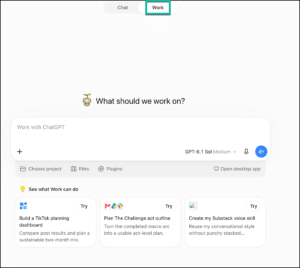
In my case, I pasted the instructions into ChatGPT Work and let it complete one research pass.

It didn’t look much different from a regular ChatGPT screen. I’m not sure what I expected, but it wasn’t this. The difference became clearer once I watched how the work happened.
In a regular ChatGPT conversation, I tend to direct the sequence. I ask a question, review the answer, decide what I want next and give another instruction. With Work, I gave it the job, the context, the rules, and the outcome I wanted. It decided many of the intermediate steps itself: what to research, which sources to follow, what to compare and what did not meet the criteria.
So the first test was simple. I pasted in the job description, let Work do the job and reviewed what came back.
Finding Its Weaknesses
For my marketing opportunities, it returned four possibilities. They looked reasonable to me, but I took the results back to the regular ChatGPT conversation where I had developed the instructions and asked it to review them.
That exposed three weaknesses. One opportunity had been classified as a Strong Fit even though its current reach could not really be verified, so the Strong Fit definition needed a higher bar. The agent found an award, which made us realize that awards and recognition should be included explicitly. It also found an interview opportunity with a significant writer audience, which raised another question we had not addressed: If the goal is selling fiction, shouldn’t a reader audience generally carry more weight than a writer audience?
We changed the instructions and ran the test again.
This time, the agent returned fewer opportunities: three Possible Fits and no Strong Fits. That was actually a better result.
Improving the instructions hadn’t meant teaching the agent to find more. It meant teaching it to reject more intelligently.
That is the purpose of this stage. You are not automating the job yet. You are checking whether the instructions produce the behaviour you intended. Your first run may expose assumptions you did not realize you were making, which is much easier to fix before you build the system around them.
Step 2: Build the Recurring Agent
At this point, I didn’t actually have an agent. I had a set of instructions I had tested in an agentic tool and knew could produce the kind of results I wanted.
Now I needed to turn those tested instructions into something that could do the job without me starting it each time. For this agent, that meant two things: it needed to run every month, and it needed somewhere to keep its results, remembering what it had already found so it wouldn’t keep giving me the same things.
For the results, I chose Notion because I was already familiar with it. If you don’t use Notion, that isn’t important. The information can live somewhere else the agent has access, such as Google Drive. The important part is giving the agent somewhere to store and retrieve its work.
Starting the Process
I created a simple Marketing Agent area in Notion with an Opportunities Log and a place for Monthly Reports. The log gives the agent a record of what it has already found, so it doesn’t return the same opportunities every month unless something has changed. The Monthly Reports give me a snapshot of what matters each time it runs.
ChatGPT has a plugin that connects ChatGPT and Notion. I ran into a hiccup, but once I straightened that out, connecting them was straightforward. Then, I tested the workflow. The agent could read the existing log, add opportunities, update them and create the monthly report where it belonged.
Here’s the part that actually turned this into the recurring agent.
I went back to the Work conversation where I had tested the instructions and told it I wanted to turn the process into a monthly scheduled task. I expected it to walk me through a series of setup screens. Instead, Work handled most of it. It asked how often I wanted the job to run, created the scheduled task and carried the instructions into it.
That scheduled task is the agent in this setup. The instructions define the job. Work provides the agentic capability. Notion gives it persistent information. The schedule is what allows the whole thing to operate without me remembering to start it every month.
That was it.
The first scheduled run will happen November 1. We have tested the instructions and the Notion workflow separately. November 1 will tell me whether the complete system works unattended.
Tip: When you ask Work about setting up the scheduled task, give it the latest version of the instructions. This way you can be sure that it is using the one that has been thoroughly tested.
Update
The first monthly run of the Marketing Opportunity Agent is complete. It ran, updated the Notion records and produced the November report like it was supposed to.
When I reviewed the results, I realized the agent had stopped searching too soon in some categories. So, we tightened the instructions around how broadly it should search and when it was allowed to stop, then ran it again. The revised run identified six new possibilities.
So the experiment worked. But it needed tweaking. Which is okay because I won’t have to verify the instructions next time. I am confident that it works the way it is supposed to.
So, Can You Use an AI Agent in Your Process?
For me, the answer is yes.
Why? Because I now have a way to identify what jobs an agent can take on. The standard advice to look at your workflow, find what you do repetitively, and determine if it needs your judgment can be a showstopper.
Using AI to help me identify potential tasks was a gamechanger. It didn’t need to look at my whole ecosystem. It looked at what we were already working on—The Call to Witchery marketing— and suggested three areas where an agent might help.
What I learned was that the task doesn’t have to be something I do every day. It just needs to be relevant to the process—something repeatable and operational.
Things like gathering information, checking it, comparing options, monitoring for changes, organizing results and preparing information. I am keeping the decision-making as to which opportunities to pursue.
Will every task need an agent? Absolutely not. Some will still be better handled with a prompt, an automation or by me.
For me, the question is no longer whether agents have a place in my process. It’s where I’ll use the next one.
Update
Since I wrote this post, the line between “agent” and “regular AI” has started to disappear. Anthropic has folded Cowork’s capabilities into Claude itself. The same conversation where you talk through an idea can now research, build files, and set up scheduled tasks. There’s no separate tool to switch to. ChatGPT has indicated they will do the same before the end of the year. The process in this post doesn’t change: find the job, define it, test the instructions, then schedule it. What changes is where you do it. Your tested instructions are still the most valuable thing you build, and they now travel with you into whatever tool you already use.
Have you ever built an AI agent for your writing process? If you haven’t, where might one make your writing process easier? Let us know in the comments!
PRACTICE
Set a timer for fifteen minutes.
Choose one project you are actively working on and ask the AI you already use:
Look at the work we’ve been doing on this project and identify three tasks that might be good candidates for an AI agent. Focus on work involving gathering, checking, comparing, monitoring, organizing or preparing information. Don’t assume every task needs an agent. For each suggestion, explain why it might be suitable and where my judgment would still be required.
Review the three suggestions. Ask yourself whether an agent could complete several steps without you directing every one, whether it could prepare the information while leaving the judgment to you, and whether handing off the work would actually save enough time to be worthwhile.
Then choose one.
Start by describing the agent’s job in one sentence. Then ask AI to help you work out what it would need to know to do that job well and where it must stop and return control to you.
Share your results in The Write Practice Pro workshops. Not a member yet? Join us here.
CHECK OUT THE HOTTEST DEALS AND MORE ON AMAZON!

Sunrise on the Reaping (The Hunger Games)
$13.48 (as of November 7, 2026 03:11 GMT +00:00 - More infoProduct prices and availability are accurate as of the date/time indicated and are subject to change. Any price and availability information displayed on [relevant Amazon Site(s), as applicable] at the time of purchase will apply to the purchase of this product.)
Cozy Corner: Coloring Book for Adults and Kids (Cozy Spaces Coloring)
$5.27 (as of November 7, 2026 03:11 GMT +00:00 - More infoProduct prices and availability are accurate as of the date/time indicated and are subject to change. Any price and availability information displayed on [relevant Amazon Site(s), as applicable] at the time of purchase will apply to the purchase of this product.)
In the Shadow of Eight: Surviving the Reality of My Childhood
$19.50 (as of November 7, 2026 03:11 GMT +00:00 - More infoProduct prices and availability are accurate as of the date/time indicated and are subject to change. Any price and availability information displayed on [relevant Amazon Site(s), as applicable] at the time of purchase will apply to the purchase of this product.)
EXTRAordinary! A Little EXTRA to Reach BIG Dreams
$19.99 (as of November 7, 2026 03:11 GMT +00:00 - More infoProduct prices and availability are accurate as of the date/time indicated and are subject to change. Any price and availability information displayed on [relevant Amazon Site(s), as applicable] at the time of purchase will apply to the purchase of this product.)








Post Comment