Unlock the Secret Trick Top Marketers Use to Instantly Decode Their Social Media Audience!
Do you ever wish you had a clearer picture of your audience on social media so you could create better content for them? Or better yet, just ask them directly what they want to see?
Most people think of social media polls as a way to boost engagement. And they are. But that’s only part of the story.
Used properly, polls and surveys give you something far more valuable. Real insight into what your audience actually cares about.
In this post, you’ll learn how to use social media polls and surveys to understand your audience and create content they actually want.
Let’s get into it.
1. Understand why audience research is important
You might think it’s enough to create any and all content that even remotely covers topics that relate to your niche, but this couldn’t be further from the truth.
Audiences are a lot more complex than that. Your niche likely has several audiences within it. That’s why it’s important for you to tailor your content to your target audience.
This could be members of your niche who are at a certain skill level (beginner, intermediate, advanced or expert) or who are mostly interested in a specific subtopic (“electric guitar” as opposed to the more broad “guitar” niche).
If you’re not sure who your target audience is, a few polls or a survey can help you identify it.
Audience research allows you to you uncover anything you think might help you create better content, including:
- Subtopics your audience is interested in
- What they think about certain topics
- Social media platforms they use
- When they browse social media
- Why they browse social media
- Whether or not they’re satisfied with your content
2. Choose a tool
You can run polls natively on a lot of social media platforms:
- Instagram – Add polls to stories. It’s under the Stickers menu.*
- Facebook – Add polls to stories.
- Twitter (X) – Create poll posts.
- YouTube – Create poll posts for the Community tab.
- Bluesky – Not a native feature, but you can create polls with third-party apps.
- Threads – Add a poll to a post.
- LinkedIn – Create a poll post.
*You can only add quizzes to reels. Although they allow you to ask your audience a question, they make you designate one option as the correct answer to that question. Polls are opinion based. Therefore, they’re not meant to have a correct answer.
If you want to ask your audience more than one question at a time or get feedback from your TikTok audience, you’re going to need to use a survey.
Here are a few survey tools you can use:
- ConvertBox – Not technically a survey or poll maker, but it does have a poll-based opt-in form that allows your audience to segment themselves as they join your email list. This is a better option because you can easily capture leads when/if it makes sense to.
- Google Forms – Free form tool your audience is likely familiar with.
- Typeform – A simple survey and poll maker. It allows you to create surveys that ask one question per page as well as polls where every option is visible. Comes with templates and plenty of marketing features.
- SurveyMonkey – Simple survey and poll maker with templates, marketing features and insightful analytics.
- SurveyPlanet – Simple survey tool that’s also great for creating surveys that show one question at a time. Comes with templates.
- Quiz and Survey Master – Survey plugin for WordPress.
If you go the survey maker route, you’ll need to promote your survey link.
Here are methods you can use to promote links on social media:
- Promote it directly in the post body itself. This is not an option on TikTok and Instagram.
- Add the link as your bio link. This removes your current bio link.
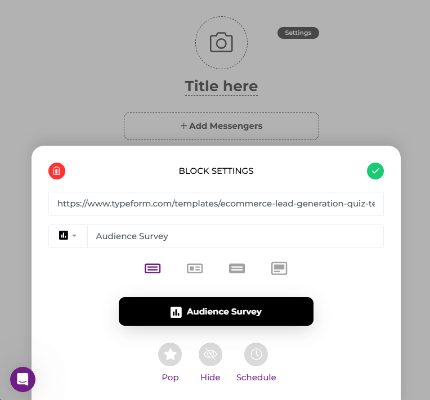
- Add the link to your link-in-bio page, a simple web page you can add several links to.
Shorby is a suitable tool for the third option. It’s very easy to use.
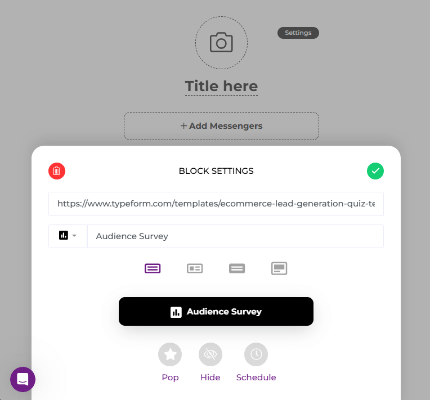
It is, however, a paid tool.
Alternatively, you could use Viraly. It’s primarily a social media scheduler but it offers a free plan that includes access to their link-in-bio page tool.
Their link-in-bio page tool also happens to be one of the best on the market.
Get started with Viraly for free.
3. Create a poll
Polls are great if you only need to ask your audience one simple question.
A lot of social media polls only allow you to add four options, but you can add unlimited options if you use a dedicated survey or poll maker.
The most important aspect of a poll is the way it only allows your audience to choose one option.
By asking your audience a simple question, giving them up to four options to pick from and only allowing them to pick one of those options, you can really learn a lot about their preferences.
Polls posted as Instagram and Facebook stories expire after 24 hours. This is because Instagram and Facebook stories themselves expire after 24 hours.
Twitter (X) allows you to choose a duration of up to a week. This means your audience has up to a week for the poll to show up in their feeds so they can respond to it.
Try using polls for the following purposes on social media:
- Opinion – Ask your audience’s opinion about a topic.
- Example: What is the most overrated electric guitar brand?
- Insight – Learn more about your audience in general.
- Example: What is your favorite electric guitar brand?
- Analytical – Learn more about your audience’s habits.
- Example: How often do you practice?
4. Create a multiple-choice poll
If you think your audience might have more than one preference, create a multiple-choice poll instead.
Your audience can only select one option when you use native social media polls, so you’ll have to use a survey tool and only add one question to it.
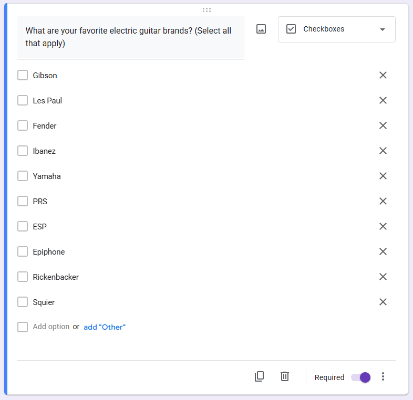
It’s best to use plural language in your question so that your audience knows they can select more than one option. You can also put a short notice in parentheses, such as “(select all that apply).”
In your survey tool, make sure you choose the Checkboxes option, and mark the question as “required.”
Here’s an example in Google Forms:
Use multiple-choice polls for the same purpose as you would a regular poll, but only use them when you want your audience to be able to select more than one option.
Stick with single-choice polls if you want to force your audience to be more decisive. This will give you more accurate data as your audience is likely to be more selective with their answers if they’re only able to choose one.
Once your poll is complete, add it to your link-in-bio page on Instagram and TikTok or as your bio link on these platforms before you promote it.
5. Create a multiple-choice survey
Surveys are fantastic tools to use to conduct audience research. They allow you to gain more insight into your audience by asking them a series of questions.
Social media content is fleeting, so it’s best if your survey is as well. Try to ask no more than five questions to increase your odds of receiving more completed surveys.
The most important thing is to make sure each question belongs to the same theme. If I ask my audience what their favorite guitar brand is, I shouldn’t also ask which guitarists they think is overrated.
The best part about using surveys is the number of question types you’re able to add to your survey. Specifically, the text-based question types where your audience can enter a short or long answer.
This is a fantastic option to include in case you’re worried that you forgot to include something as an option.
Another useful aspect about surveys are the conditional logic features they unlock depending on which survey tool you use.
Conditional logic is a feature that allows you to set up triggers and actions for your survey, or “if this, then that” rules.
For example, if your primary question asks your audience, “what is your favorite guitar brand,” and one of your options is Ibanez, you could ask a follow-up question that only appears if your audience selects the Ibanez option, such as “which guitar models do you own from Ibanez?”
Some survey makers, such as Typeform, have ranking question types that allow your audience to rearrange options based on how they’d rank them.
Overall, surveys are an effective way to expand on a question with additional questions, which ultimately leads to more data for you.
6. Use the data you acquire to optimize your social media marketing strategy
There’s quite a bit you can learn by asking your audience simple questions on social media.
If you’re in the guitar niche, knowing which brands your audience prefers lets you know which brands to focus on for reviews, unboxing content, product demonstrations and tutorials.
If you ask your audience about other social media platforms they use, you’ll know which other platforms you should be creating content for.
Polls and surveys help you align your social media content and overall marketing strategy with what your audience wants to see.
A lot of platforms have analytics you can view. There are even dedicated social media analytics tools out there. Plus, you can get a pretty good idea of your audience’s preferences by conducting keyword research and product research.
But it’s one thing to guess what your audience prefers or wants to see. It’s another thing to have them tell you outright.
Make a list of every piece of data you feel would help you understand your audience a little better. Then, come up with questions and answers that would help you uncover that information.
Final thoughts
When you’re just getting started as a blogger or content creator, there is a lot of guesswork involved.
But once you have an audience, no matter the size, you can start gathering qualitative data.
This is the data that matters most.
It’ll help you take a strategy based on guesswork and turn it into a solid strategy based on nothing but facts and hard data.
Disclosure: Our content is reader-supported. If you click on certain links we may make a commission.