Why Embracing Frivolity Might Be the Most Serious Act of All: A Provocative Take by Jehanne Dubrow
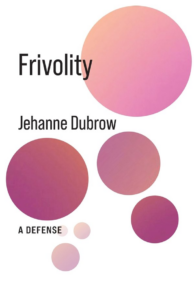
There are critiques of frivolities, and in one she cites both the late-Renaissance French essayist Michel de Montaigne’s “On Vanity,” and literary scholar Sianne Ngai’s Our Aesthetic Categories. In “On Vanity,” Dubrow notes that Montaigne’s writing in general has often been considered its own frivolity, and notes in this specific essay that his version of vanity is “false or empty. Vanity is the fruitless.” Then, Dubrow pushes Montaigne toward Ngai’s more modern ideas to lament the frivolous as “the debris of late-stage capitalism . . . our worst impulse to possess.” Having carefully constructed her argument, Dubrow then pivots to a critique of such a narrow view, dismantling the assertions she so painstakingly put together: “Pure frivolity is like a palate cleanser—a small bowl of raspberry sorbet—that we consume before returning to the next somber course of a meal.” Dubrow often resists tidy resolutions, this being one of many examples.