Why Embracing Frivolity Might Be the Most Serious Act of All: A Provocative Take by Jehanne Dubrow
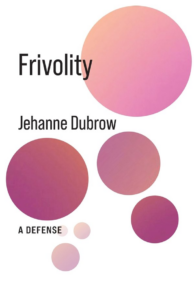
As we follow her through numbered sections, Dubrow nearly tumbles into insight. “Merriment,” she writes, “is a shield we use, so no one will notice our suffering and call out with sudden concern.” And I cannot help but remember that this work came out of the COVID-19 pandemic, where many of us, unyoked from our regular routines, often searched for ways to divert ourselves from the chaos around us, with activities such as baking, gaming, binge-watching, and crafting, to name a few.
“Frivolity,” Dubrow reminds us, “is a disguise.” This disguise can have its usefulness. To make her point, Dubrow calls upon Flaubert’s Emma Bovary, a character who embraces the gendered notions of frivolity that Dubrow critiques in the earliest pages of the book. “For Emma, shopping is a release,” Dubrow maintains. “It’s an activity that approximates freedom and agency.” Yet, frivolity can also be subversive, a point Dubrow nearly insists on in her observation of Jane Austen’s heroines. “In Austen’s world, beauty is useful,” Dubrow asserts, and it is this usefulness that has kept Austen relevant for hundreds of years. Dubrow artfully catalogues Austen’s leading women to make this point, that their marriage prospects or lack thereof, which is to say their life prospects, hinge on the useful tool that beauty provides or withholds. That is the essential pleasure in reading Jane Austen, Dubrow argues.